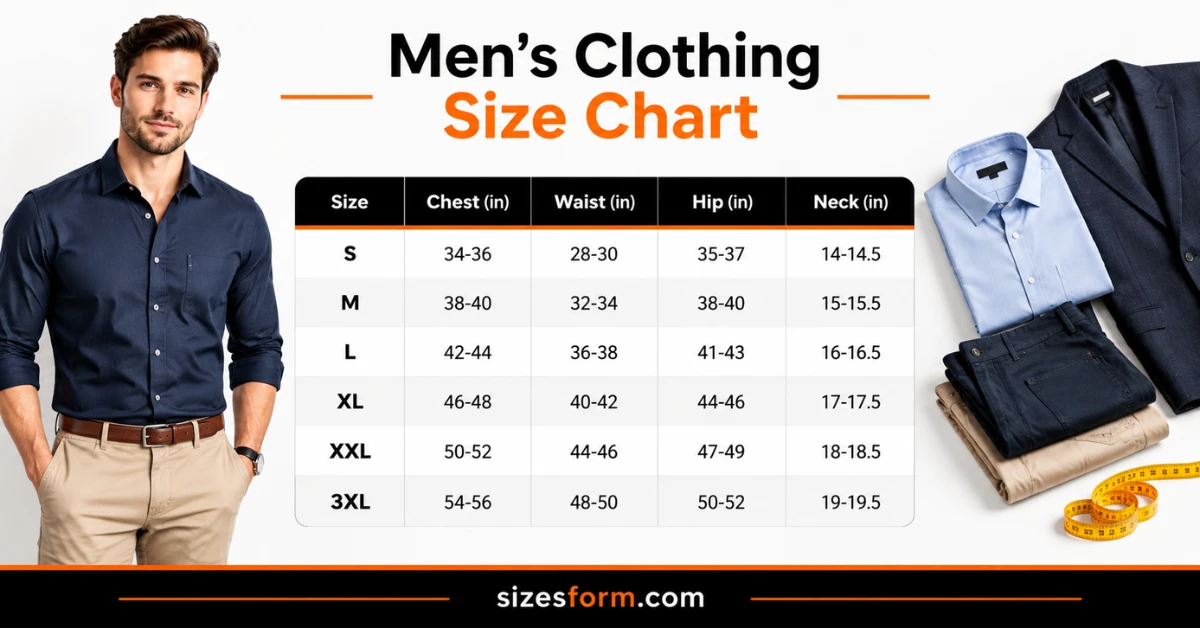
A men’s clothing size chart translates real body measurements — chest, waist, and neck — into a trusted size, from Small (34-36″) to XXL (50-52″), with 32×32 or 40R style numbers for pants and suits.
This guide covers every major category — shirts, pants, suits, outerwear, and big & tall — plus international conversions, fit types, and the mistakes that lead to returns. You’ll also get quick answers to the most-searched sizing questions.
Men’s Clothing Size Chart
Alpha sizing uses letters — S, M, L, XL, XXL. Numeric sizing uses actual inches — a 34 waist, a 42 chest. Dress shirts and suits lean numeric. Casual wear leans alpha.
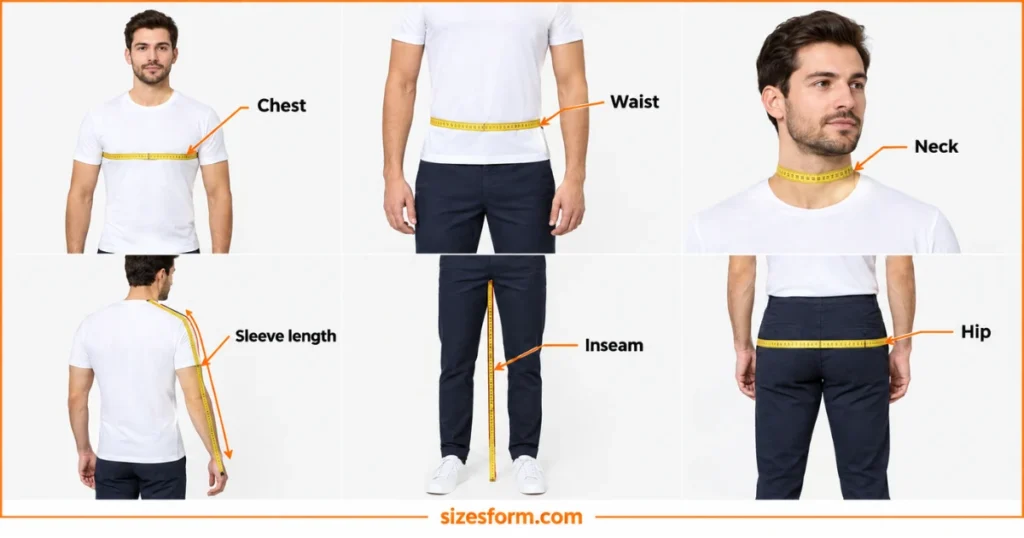
Chest — Wrap the tape under your arms and across the fullest part of your chest and shoulder blades. Keep the tape level.
Waist — Measure where you actually wear your pants, not at your belly button. Slide one finger under the tape for breathing room.
Neck — Circle the base of your neck, where a shirt collar sits. Leave one finger of slack.
Sleeve length — Bend your elbow slightly. Measure from the center of your back neck, over the shoulder, down to the wrist.
Inseam — Measure a pair of pants that already fits well, from the crotch seam to the hem. This is more reliable than measuring your leg directly.
Hip — Stand with feet together and measure around the fullest part of your seat.
Men’s Shirt Size Chart
Size
Neck (in)
Sleeve (in)
Chest (in)
S
14-14.5
32-33
34-36
M
15-15.5
33-34
38-40
L
16-16.5
34-35
42-44
XL
17-17.5
35-36
46-48
XXL
18-18.5
36-37
50-52
A dress shirt labeled 16.5/34-35 means a 16.5-inch neck paired with a 34-35 inch sleeve. This dual notation exists because a man’s neck and arm length don’t always scale together — a broad neck doesn’t guarantee long arms.
Casual shirts and polos skip this precision and use straight S–XXL sizing instead, since a looser, more relaxed fit doesn’t demand the same accuracy.
Pants use a two-number sizing system, with the waist listed first and the inseam second:
30 waist: 30, 32, or 34-inch inseam
32 waist: 30, 32, or 34-inch inseam
34 waist: 30, 32, 34, or 36-inch inseam
36 waist: 30, 32, 34, or 36-inch inseam
38 waist: 30, 32, or 34-inch inseam
40 waist: 30, 32, or 34-inch inseam
Casual pants may also use alpha sizes (S–XL), especially in athletic and activewear styles where stretch fabrics allow a more flexible fit.
Men’s Suit Size Chart
Suit sizing runs on chest measurement plus a length code. A size 40R means a 40-inch chest in a Regular length.
Chest (in)
Jacket Length
Height Range
36-38
Short (S)
5’4″-5’7″
38-44
Regular (R)
5’7″-6’1″
40-48
Long (L)
6’1″-6’4″
Suits also carry a drop — the gap between the jacket’s chest size and the trouser waist size. A standard drop is 6 inches, so a 40R jacket typically pairs with a 34-inch trouser waist.
Men’s Dress Shirt Size Chart
Men’s dress shirts use a two-number sizing system: neck size first and sleeve length second.
For example, 16.5/34–35 means a 16.5-inch neck with a 34–35-inch sleeve. Retailers use sleeve ranges because arm length can vary between people with the same neck size.
Slim fit shirts taper through the chest and waist, while classic fit provides a roomier shape. Cotton dress shirts may shrink slightly after washing, so choosing the higher end of the sleeve range can help maintain the fit.
Big and Tall Men’s Size Chart
Big and tall sizing isn’t just “extra large stretched out.” It’s a separate scale built for proportion, not just volume — a tall man and a big man need length and width added in different places.
Size
Chest (in)
Waist (in)
Height
XLT
46-48
40-42
6’3″-6’6″
2XLT
50-52
44-46
6’3″-6’6″
3XL
54-56
48-50
up to 6’2″
4XL
58-60
53-55
up to 6’2″
The T suffix (like XLT) signals tall sizing — extra length in the torso and sleeves without adding width. A plain 2XL, by contrast, adds width but keeps standard length.
International Men’s Size Conversion Chart
US sizes don’t match UK, European, or Japanese sizing directly — the difference is larger than most shoppers assume.
US
UK
EU
Japan
S
S
46
M
M
M
48-50
L
L
L
52
LL
XL
XL
54-56
LL
XXL
XXL
58
LL
European sizes run roughly 10 points higher than the equivalent US number for suits and coats — a US 40 lines up with a EU 50. Japanese sizing compresses everything into fewer, tighter bands, so a US Large can land closer to a Japanese LL.
I am the admin and author of SizesForm, researching, verifying, and explaining measurements, dimensions, weights, and sizes in simple terms to help readers understand everyday comparisons accurately and confidently.