A kids shoe size chart lists US sizes by foot length: infant 0-4 (3.1-4.5 in), toddler 4.5-10 (4.6-6.5 in), little kid 10.5-3 (6.6-8.5 in), and big kid 3.5-7 (8.6-9.75 in).
Sizing restarts at 1Y after size 13, and the right size is the longest foot’s length plus about ½ inch of toe room.
This guide gives you size charts by age, a shoe width guide, and simple home-measuring steps. It also explains C, T and Y sizes, shows when to size up, and answers common questions.
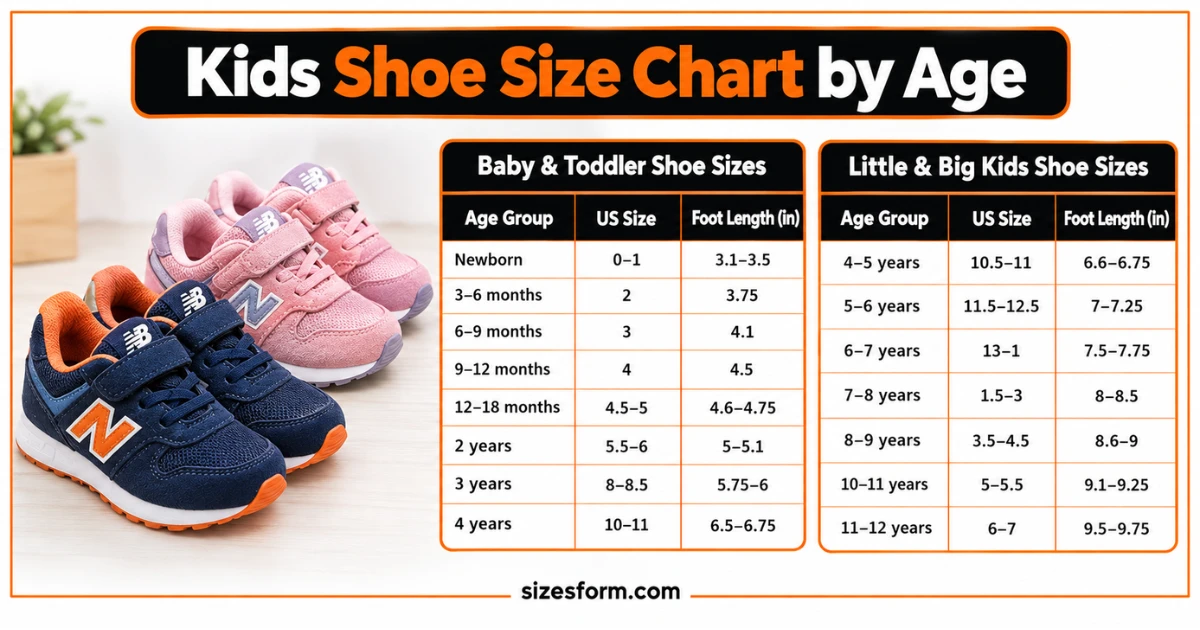
Kids Shoe Size Chart by Age
| Age | US Size | Foot Length (in) |
|---|---|---|
| Newborn | 0–1 | 3.1–3.5 |
| 3–6 months | 2 | 3.75 |
| 6–9 months | 3 | 4.1 |
| 9–12 months | 4 | 4.5 |
| 12–18 months | 4.5–5 | 4.6–4.75 |
| 2 years | 5.5–6 | 5–5.1 |
| 3 years | 8–8.5 | 5.75–6 |
| 4 years | 10–11 | 6.5–6.75 |
| 5 years | 11.5–12.5 | 7–7.25 |
| 6 years | 13–1 | 7.5–7.75 |
| 7 years | 1.5–2.5 | 8–8.25 |
| 8 years | 3–3.5 | 8.5–8.6 |
| 9 years | 4–4.5 | 8.75–9 |
| 10 years | 5–5.5 | 9.1–9.25 |
| 11 years | 6 | 9.5 |
| 12 years | 6.5–7 | 9.6–9.75 |
Related Post: Shoe Size Chart: Match Foot Length in Inches & CM to US, UK, EU Sizes
Baby & Infant Shoe Size Chart
| US Size | Approx. Age | Foot Length (in / cm) | UK | EU |
|---|---|---|---|---|
| 0 | Newborn | 3.1 / 8.0 | 0 | 15 |
| 1 | 0–3 months | 3.5 / 8.9 | 0.5 | 16 |
| 2 | 3–6 months | 3.75 / 9.5 | 1.5 | 17 |
| 3 | 6–9 months | 4.1 / 10.5 | 2.5 | 18.5 |
| 4 | 9–12 months | 4.5 / 11.4 | 3.5 | 19.5 |
Toddler Shoe Size Chart
| US Size (T) | Approx. Age | Foot Length (in / cm) | UK | EU |
|---|---|---|---|---|
| 4.5 | 12–18 months | 4.6 / 11.7 | 3.5 | 20 |
| 5 | 18–24 months | 4.75 / 12.1 | 4 | 20 |
| 5.5 | 2 years | 5.0 / 12.7 | 4.5 | 21 |
| 6 | 2 years | 5.1 / 13.0 | 5 | 22 |
| 6.5 | 2–2.5 years | 5.25 / 13.3 | 5.5 | 22 |
| 7 | 2.5 years | 5.5 / 14.0 | 6 | 23 |
| 7.5 | 2.5–3 years | 5.6 / 14.3 | 6.5 | 23 |
| 8 | 3 years | 5.75 / 14.6 | 7 | 24 |
| 8.5 | 3 years | 6.0 / 15.2 | 7.5 | 25 |
| 9 | 3.5 years | 6.1 / 15.6 | 8 | 25 |
| 9.5 | 3.5 years | 6.25 / 15.9 | 8.5 | 26 |
| 10 | 4 years | 6.5 / 16.5 | 9 | 27 |
Related Post: Men’s Shoe Size Chart
Boys Shoe Size Chart (Little & Big Kids)
Kids’ sizes are unisex. So this boys shoe size chart works for girls too. Little kids wear 10.5–3, and big kids wear 3.5–7.
Little Kids Shoe Size Chart (4–8 Years)
| US Size | Approx. Age | Foot Length (in / cm) | UK | EU |
|---|---|---|---|---|
| 10.5 | 4 | 6.6 / 16.8 | 10 | 27.5 |
| 11 | 4–5 | 6.75 / 17.1 | 10.5 | 28 |
| 11.5 | 5 | 7.0 / 17.8 | 11 | 28.5 |
| 12 | 5 | 7.1 / 18.1 | 11.5 | 29.5 |
| 12.5 | 5–6 | 7.25 / 18.4 | 12 | 30 |
| 13 | 6 | 7.5 / 19.1 | 12.5 | 31 |
| 13.5 | 6 | 7.6 / 19.4 | 13 | 31.5 |
| 1 | 6–7 | 7.75 / 19.7 | 13.5 | 32 |
| 1.5 | 7 | 8.0 / 20.3 | 1 | 33 |
| 2 | 7 | 8.1 / 20.6 | 1.5 | 33.5 |
| 2.5 | 7–8 | 8.25 / 21.0 | 2 | 34 |
| 3 | 8 | 8.5 / 21.6 | 2.5 | 35 |
Big Kids Shoe Size Chart (8–12 Years)
| US Size | Approx. Age | Foot Length (in / cm) | US Men’s | US Women’s | UK | EU |
|---|---|---|---|---|---|---|
| 3.5 | 8–9 | 8.6 / 21.9 | 3.5 | 5 | 3 | 35.5 |
| 4 | 9 | 8.75 / 22.2 | 4 | 5.5 | 3.5 | 36 |
| 4.5 | 9 | 9.0 / 22.9 | 4.5 | 6 | 4 | 36.5 |
| 5 | 10 | 9.1 / 23.2 | 5 | 6.5 | 4.5 | 37.5 |
| 5.5 | 10–11 | 9.25 / 23.5 | 5.5 | 7 | 5 | 38 |
| 6 | 11 | 9.5 / 24.1 | 6 | 7.5 | 5.5 | 38.5 |
| 6.5 | 11–12 | 9.6 / 24.4 | 6.5 | 8 | 6 | 39 |
| 7 | 12 | 9.75 / 24.8 | 7 | 8.5 | 6.5 | 40 |
Related Post: Women’s Shoe Size Chart
Kids Shoe Width Chart
| Size | Standard M (in / cm) | Wide W (in / cm) | X-Wide XW (in / cm) |
|---|---|---|---|
| Toddler 5 | 5⅜ / 13.8 | 5⅞ / 14.8 | 6¼ / 15.8 |
| Little Kid 11 | 6½ / 16.5 | 6⅞ / 17.6 | 7½ / 19.2 |
| Little Kid 1 | 7⅛ / 18.0 | 7½ / 19.1 | 8⅛ / 20.7 |
| Big Kid 6 | 8¼ / 21.1 | 8¾ / 22.1 | 9⅜ / 23.7 |
Toddler (T), Child (C) & Youth (Y) Sizes Explained
| Code | Meaning | Size Range | Typical Age |
|---|---|---|---|
| T / C | Toddler or Child | 4–13.5 | 1–6 years |
| Y | Youth | 1–7 | 6–12 years |
Kids Shoe Size Conversion Chart
US, UK and EU sizes use different scales. Brands may also list cm or JP sizes. When you shop across brands, match foot length first, then the size number.
| Foot Length (cm) | US Kids | UK | EU |
|---|---|---|---|
| 10.5 | 3 | 2.5 | 18.5 |
| 12.7 | 5.5 | 4.5 | 21 |
| 14.0 | 7 | 6 | 23 |
| 15.2 | 8.5 | 7.5 | 25 |
| 16.5 | 10 | 9 | 27 |
| 17.8 | 11.5 | 10.5 | 29 |
| 19.1 | 13 | 12.5 | 31 |
| 20.6 | 2 | 1.5 | 33.5 |
| 21.6 | 3 | 2.5 | 35 |
| 23.2 | 5 | 4.5 | 37.5 |
| 24.8 | 7 | 6.5 | 40 |
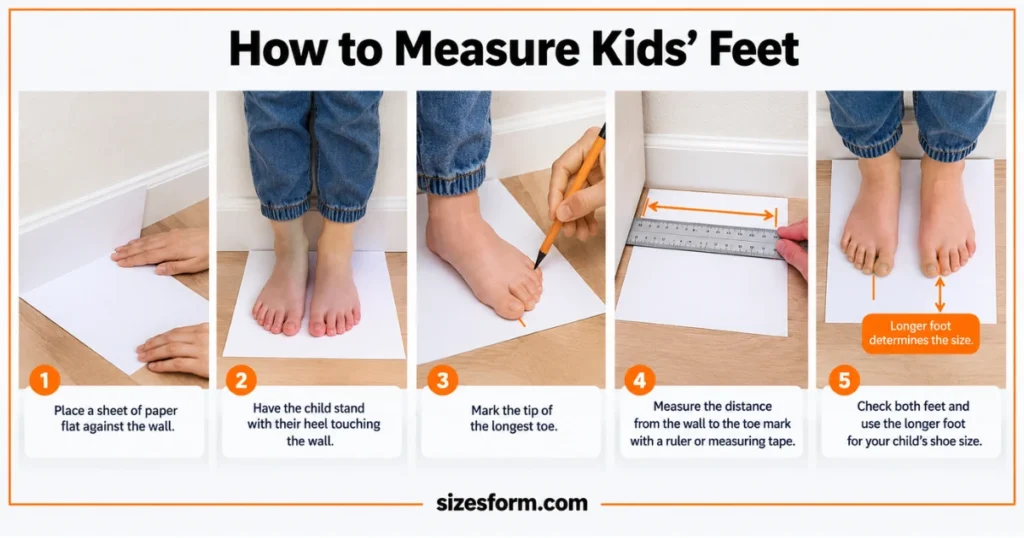
How to Measure Kids’ Feet at Home

Step-by-Step Measuring Method
- Put paper flat against a wall.
- Have your child stand with the heel touching the wall.
- Mark the tip of the longest toe.
- Measure from the wall to the mark.
- Repeat for the other foot.
- Use the larger number.
One foot is often slightly longer than the other. That’s normal.
Printable Chart vs. Paper Method
A printable foot chart works well if printed at 100% scale. Check the scale with a credit card, as Nike suggests. No printer? The paper method gives the same result.
Measuring Wiggly Toddlers
Keep it quick. Trace both feet in under a minute. Let your child pick the pen. Wear the socks they’ll use with the shoes, as Ralph Lauren advises.
FAQs
Is size 13 the same as size 1?
No. Size 13 is the last little-kid size, and size 1Y starts again about ¼ inch longer.
What are kids shoe sizes by age?
Babies wear sizes 0–4, toddlers 4.5–10, little kids 10.5–3, and big kids 3.5–7.
Is youth large a 10 or 12?
Youth large is a clothing size, not a shoe size. Youth shoes run from 1Y to 7Y.
Is a 5T shoe the same as a 5?
Yes, if both are toddler sizes (about 4.75 inches). A youth 5Y is much longer, about 9 inches.
How to calculate age by shoe size?
Add about one size every 3 months in year one. After that, expect half a size every 2–4 months, then roughly 1.5 sizes a year after age 4.
Is it normal for a 2-year-old boy to wear size 9 shoes?
It’s above average, since most 2-year-olds wear 5.5–7, but it’s normal if the foot measures about 6 inches.

I am the admin and author of SizesForm, researching, verifying, and explaining measurements, dimensions, weights, and sizes in simple terms to help readers understand everyday comparisons accurately and confidently.